The Arts of Logistics

Description
We live in a world where nothing is untouched by supply chains—art included. In this major contribution to the study of contemporary culture and supply chains, Michael Shane Boyle has assembled a global inventory of aesthetics since the 1950s that reveals logistics to be a pervasive means of artistic production. The Arts of Logistics provides a new map of supply chain capitalism, scrutinizing how artists retool technologies designed for circulating commodities. What emerges is a magisterial account of the logistics revolution that foregrounds the role played by art in the long downturn of global capitalism.
With chapters on art produced from technologies including ships, barrels, containers, and drones, Boyle narrates the long history of art’s connection to logistics, beginning in the transatlantic slave trade and continuing today in Silicon Valley’s dreams of automation. The global reach of the artists considered reflects the geographies of supply chain capitalism itself. In taking stock of how performance, sculpture, and popular culture are entangled in trade and racialized labor regimes, Boyle profiles influential work by artists such as Christo and Allan Kaprow alongside that of contemporary figures including Cai Guo-Qiang and Selina Thompson. This incisive study demonstrates that art and logistics are linked by the infrastructures and violence that keep supply chains moving.
Reviews
*Shortlisted for the 2025 Deutscher Memorial Prize, recognizing “the best and most innovative new writing in or about the Marxist tradition.”
“This is the book about logistics and art that we have been waiting for. Both broad and deep enough to do justice to its topic, it is engagingly written and a pleasure to read.”
—Susan Zieger, University of California Riverside
“This book is by far one of the most brilliant books in a crop of very brilliant books on logistics. It is original, beautifully written, gorgeously illustrated, and it fizzes and pops with imagination, righteous outrage, hefty analysis, and humor.”
—Laleh Khalili, University of Exeter
“This book, finally, presents a clear-eyed and frank assessment of the real political affordances and potential of artistic production at present, weighed against logistical capitalism and its ruthlessly pragmatic ‘politics of operations’, which are nothing if not efficient. It is underpinned by, and subterraneously develops, a theory of art’s position in the constellation of political forces in the present. In this regard, it is an exemplary and relevant study for anyone interested in thinking about the intersections between art and the capitalist mode of production today, beyond the admittedly specialised subject of artistic production’s relation to supply chains.”
—Steyn Bergs, Art History
“A brilliant examination of the logistical mode of artistic production. This is aesthetic theory down at the docks and across the sea—in solidarity, antagonistic, yet alive to the repurposing of logistical infrastructures within an artistic imagination.”
—Ned Rossiter, Western Sydney University
—Featured on: On TAP: A Theatre and Performance Studies Podcast, Episode 74
Acquire
Available through Stanford University Press here. 20% off with code: BOYLE20
For other options, please e-mail the author.
Postdramatic Theatre and Form
Description
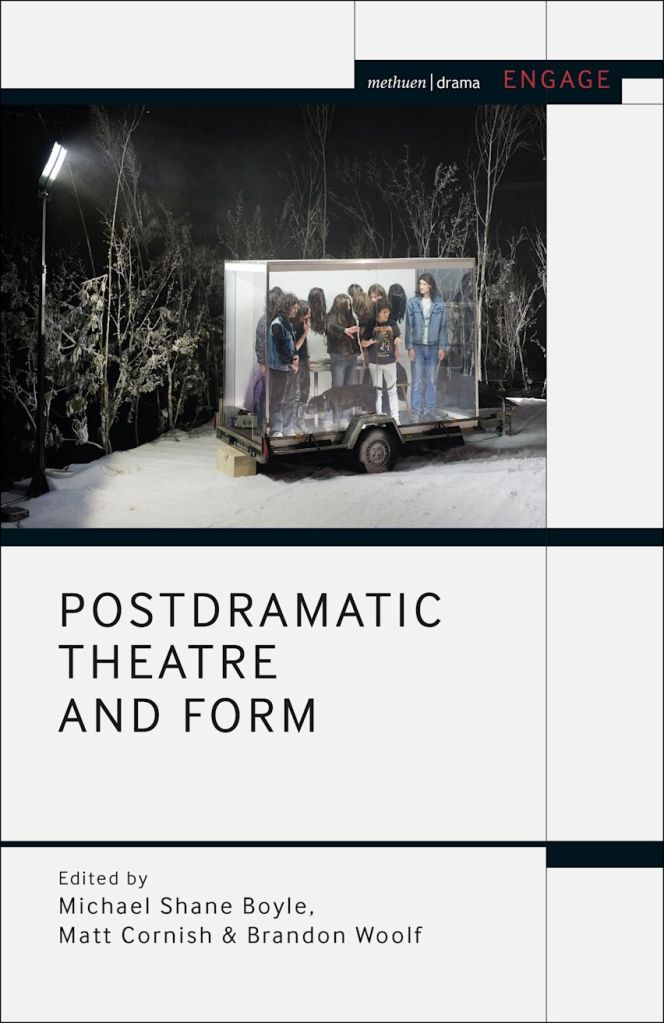
Postdramatic theatre is an essential category of performance that challenges classical elements of drama, including the centrality of plot and character. Tracking key developments in contemporary European and North American performance, this collection redirects ongoing debates about postdramatic theatre, turning attention to the overlooked issue on which they hinge: form.
Contributors draw on literary studies, film studies and critical theory to reimagine the formal aspects of theatre, such as space, media and text. The volume expands how scholars think of theatrical form, insisting that formalist analysis can be useful for studying the ways theatre is produced and consumed, and how theatre makers engage with other forms like dance and visual art. Chapters focus on a range of interdisciplinary artists including Tadeusz Kantor, Ann Liv Young and Ryan Trecartin and Lizzie Fitch, as well as theatre’s enmeshment within institutional formations like funding agencies, festivals, real estate and healthcare.
A timely investigation of the aesthetic structures and material conditions of contemporary performance, this collection refines what we mean, and what we don’t, when we speak of postdramatic theatre.
Acquire
Available from Bloomsbury here.
 Shane Boyle